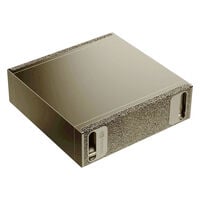
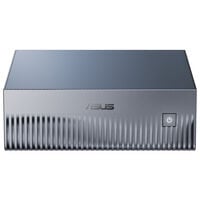
NVIDIA DGX Spark for Local AI and AI Agents
NVIDIA DGX Spark is a compact AI computer for developers, researchers, data scientists, and businesses. The NVIDIA GB10 Grace Blackwell Superchip, 128 GB of shared system memory, and the pre-installed NVIDIA AI software stack enable the local development and execution of large language models, autonomous AI agents, machine-learning applications, and data-intensive AI workflows.
With dimensions of just 150 × 150 × 50.5 mm, NVIDIA brings the Grace Blackwell platform to a compact desktop system. DGX Spark can be used directly with a monitor, keyboard, and mouse or as a network-connected AI computer via SSH, Remote Desktop, and NVIDIA Sync.
What Is NVIDIA DGX Spark?
NVIDIA DGX Spark is a complete hardware and software platform for local AI development. Unlike a conventional mini PC, the system combines a Blackwell GPU, a 20-core Arm CPU, 128 GB of coherent system memory, fast networking technology, and an operating system designed for AI workloads.
This allows you to test, validate, optimise, and run AI models locally before transferring them to a larger workstation, data centre, or cloud infrastructure if required. Sensitive data can remain within your own working environment.
Who Is NVIDIA DGX Spark Suitable For?
DGX Spark is aimed at users who want to develop or test modern AI applications locally without having to book cloud resources for every step. The following overview shows typical applications.
| Application |
Typical Tasks with DGX Spark |
| Local LLMs |
Load, test, compare, and deploy language models locally for your own applications |
| AI Agents |
Develop, validate, and continuously run autonomous and multi-stage AI agents locally |
| Fine-Tuning |
Adapt pre-trained models using your own data and methods such as LoRA or QLoRA |
| Data Science |
Analyse data, train machine-learning models, and develop GPU-accelerated pipelines |
| Computer Vision |
Process image and video data and test recognition, analysis, and inference models |
| Robotics & Edge AI |
Develop applications with NVIDIA Isaac, Metropolis, Holoscan, and other edge frameworks |
| Research & Education |
Provide AI models and development environments locally for laboratories, universities, and learning projects |
The Most Important Benefits of NVIDIA DGX Spark
GB10 Grace Blackwell Superchip
The NVIDIA GB10 combines a Blackwell GPU with a powerful 20-core Arm CPU. Fifth-generation Tensor Cores enable up to 1 PFLOP of FP4 AI performance in theoretical calculations with sparsity.
128 GB Unified Memory
The CPU and GPU access a shared pool of 128 GB LPDDR5x memory. This allows larger models to be loaded than would be possible with the separate VRAM of many conventional desktop graphics cards.
Pre-Installed AI Software Stack
NVIDIA DGX OS, CUDA, development libraries, container support, and access to NVIDIA NGC and NVIDIA NIM form a coordinated environment for AI development and inference.
Compact Desktop System
DGX Spark requires very little space and can be operated directly at the workstation or as a network system. The external power supply provides up to 240 watts, while the GB10 Superchip is specified with a 140-watt TDP.
NVIDIA DGX Spark – Technical Specifications
| Feature |
NVIDIA DGX Spark |
| Architecture |
NVIDIA Grace Blackwell |
| Superchip |
NVIDIA GB10 Grace Blackwell |
| GPU |
NVIDIA Blackwell with 5th-generation Tensor Cores |
| CPU |
20-core Arm, 10× Cortex-X925 and 10× Cortex-A725 |
| AI Performance |
Up to 1 PFLOP FP4, theoretically with sparsity |
| System Memory |
128 GB LPDDR5x Unified Memory |
| Memory Bandwidth |
273 GB/s |
| Storage |
4 TB self-encrypting NVMe M.2 SSD |
| Network |
10 Gigabit Ethernet, ConnectX-7 with up to 200 Gbit/s, and Wi-Fi 7 |
| USB |
4× USB Type-C |
| Display Output |
1× HDMI 2.1a and up to 3× DisplayPort via USB-C |
| Operating System |
NVIDIA DGX OS |
| Dimensions |
150 × 150 × 50.5 mm |
| Weight |
1.2 kg |
| Power Supply |
240 watts, external |
What Does 128 GB Unified Memory Mean?
In a conventional PC, the processor and graphics card usually have separate memory. NVIDIA DGX Spark, by contrast, uses a shared, coherent memory pool. This allows the CPU and GPU to access the same data without having to constantly copy it between system memory and graphics memory.
The 128 GB of Unified Memory makes it possible to load large language, vision, and multimodal models locally. However, the parameter count alone does not determine whether a model fits entirely into memory. Precision, quantisation, context length, KV cache, and the software used also require memory.
A high memory capacity also does not automatically mean correspondingly high processing speed. The required throughput depends on the model, quantisation, input length, and the respective framework.
How Large Can the AI Models Run by DGX Spark Be?
According to NVIDIA, a single DGX Spark can process AI models with up to 200 billion parameters for inference, testing, and validation. For fine-tuning, NVIDIA specifies models with up to 70 billion parameters.
These figures require a suitable model architecture, precision, and software configuration. Highly quantised models require less memory than models with FP16 or FP32 weights. At the same time, memory requirements increase with long context windows and multiple simultaneous users.
| Configuration |
Use Specified by NVIDIA |
Typical Scenario |
| One NVIDIA DGX Spark |
Models with up to 200 billion parameters |
Local inference, development, prototyping, data science, and fine-tuning |
| Two Connected DGX Spark Systems |
Models with up to 405 billion parameters |
Distributed inference and larger models over a fast ConnectX-7 connection |
Connecting Two NVIDIA DGX Spark Systems
Two DGX Spark systems can be connected directly via NVIDIA ConnectX-7. The fast network enables distributed AI workloads in which calculations and model data are divided across multiple systems.
For a configuration consisting of two DGX Spark systems, NVIDIA specifies working with models of up to 405 billion parameters. This requires supported frameworks, suitable model distribution, and a compatible ConnectX connection.
Suitable network components and cables are required for the connection. The software used must also support distributed calculations via NCCL, MPI, or another supported method.
NVIDIA DGX Spark Software
NVIDIA DGX OS
DGX Spark is supplied with NVIDIA DGX OS. The operating system is based on Ubuntu and includes the required drivers, libraries, and tools for AI, machine-learning, and data-science workloads.
CUDA and AI Frameworks
The NVIDIA software stack supports CUDA, cuDNN, TensorRT-LLM, PyTorch, and other Blackwell-optimised frameworks for training, fine-tuning, and inference.
Containers and NVIDIA NGC
Docker and the NVIDIA Container Runtime make it easier to create reproducible development environments. Optimised containers, models, and other AI resources are available through NVIDIA NGC.
NVIDIA NIM and JupyterLab
NVIDIA NIM provides optimised inference microservices. Models, notebooks, and data-analysis workflows can be edited directly in the browser via the DGX Dashboard and integrated JupyterLab.
Important: DGX Spark Uses an Arm64 CPU
The integrated Grace processor is based on the Arm64 architecture rather than the x86-64 instruction set commonly used in conventional desktop PCs. Modern AI frameworks and the containers provided by NVIDIA are adapted for DGX Spark.
However, your own applications, dependencies, or containers must also support Arm64. Pure x86-64 programs cannot always be used unchanged and may need to be recompiled, adapted, or replaced with a compatible alternative.
NVIDIA DGX Spark or a Conventional AI Workstation?
DGX Spark and a self-configured AI workstation take different approaches. DGX Spark offers a compact, coordinated complete platform with large Unified Memory and pre-installed software. A conventional workstation, by contrast, can be adapted more extensively to individual hardware requirements.
| Feature |
NVIDIA DGX Spark |
Conventional AI Workstation |
| Memory |
128 GB of shared CPU and GPU memory |
Separate system memory and graphics memory |
| Space Requirements |
Very compact desktop system |
Usually significantly larger depending on the case and hardware |
| Expandability |
Integrated platform with a fixed CPU, GPU, and memory configuration |
Graphics cards, RAM, storage, and other components can be replaced |
| Software Platform |
Pre-installed DGX OS and NVIDIA AI software stack |
Operating system and development environment must be set up manually |
| CPU Architecture |
Arm64 |
Usually x86-64 |
| Typical Use |
Local models, AI agents, development, research, and inference |
Customisable multi-GPU systems, rendering, AI, and mixed professional workloads |
Local AI or Cloud?
NVIDIA DGX Spark allows many development, testing, and inference tasks to be performed locally. This means that model data, prompts, and internal documents do not have to be transferred to an external cloud service for every processing step.
A local platform can also reduce ongoing cloud costs for frequently recurring development and inference tasks. Power consumption, hardware acquisition, administration, data backup, and maintenance remain your own responsibility.
For particularly extensive training or highly variable workloads, a larger workstation, DGX Cloud, or data centre infrastructure may still be appropriate. DGX Spark is suitable, among other things, for preparing projects locally and later transferring them to larger NVIDIA platforms.
What Should I Consider When Buying NVIDIA DGX Spark?
Model Size and Workload
Check how much memory your chosen model requires with the intended quantisation and context length. In addition to the model weights, the KV cache, applications, and operating system must also fit within the 128 GB of memory.
Arm64 Compatibility
Make sure that your frameworks, containers, Python packages, and your own applications support Arm64. Older or heavily customised x86 software may require additional porting work.
Local Storage
The integrated 4 TB of storage provides space for models, containers, and datasets. Extensive model libraries, training data, and checkpoints may require additional network or USB storage.
Network and Scaling
10 Gigabit Ethernet and ConnectX-7 are available for central data storage and connecting multiple systems. Suitable ConnectX cables or network components are required for a direct high-speed connection.
Connecting and Using NVIDIA DGX Spark
DGX Spark can be used like a compact desktop computer with a monitor via HDMI or DisplayPort, a keyboard, and a mouse. Alternatively, the system can be operated over the network without its own display.
Four USB-C ports are available for displays, input devices, external storage devices, and other accessories. For network connectivity, the system offers 10 Gigabit Ethernet, Wi-Fi 7, and the powerful ConnectX-7 interface.
For full performance, use the supplied 240-watt power supply and place the system in a well-ventilated location. The ventilation openings must not be blocked by objects or other devices stacked on top of one another.
Also discover our AI PCs and AI workstations, NVIDIA RTX PRO graphics cards, and professional workstations for local AI.
FAQ – NVIDIA DGX Spark
What Is NVIDIA DGX Spark?
NVIDIA DGX Spark is a compact AI computer with a GB10 Grace Blackwell Superchip, 128 GB of Unified Memory, and a pre-installed NVIDIA AI software stack. The system is designed for local AI development, inference, fine-tuning, and data science.
Which AI Models Can NVIDIA DGX Spark Run?
NVIDIA specifies models with up to 200 billion parameters for a single DGX Spark. Actual support depends on the model architecture, quantisation, context length, memory requirements, and software used.
Can I Fine-Tune an LLM with DGX Spark?
Yes. NVIDIA specifies fine-tuning for models with up to 70 billion parameters. Methods such as LoRA and QLoRA can reduce the memory required compared with full training.
Can I Connect Two NVIDIA DGX Spark Systems?
Yes. Two systems can be connected via NVIDIA ConnectX-7 for distributed AI workloads. NVIDIA specifies models with up to 405 billion parameters for such a configuration.
Which Operating System Does DGX Spark Use?
The system uses NVIDIA DGX OS, which is based on Ubuntu and is supplied with NVIDIA drivers, CUDA, development tools, and support for containers and AI frameworks.
Does x86 Software Run on NVIDIA DGX Spark?
DGX Spark uses an Arm64 CPU. Software and containers must therefore support Arm64 or be adapted accordingly. Pure x86-64 applications cannot generally be run unchanged.
Can I Use NVIDIA DGX Spark Without a Monitor?
Yes. The system can be used locally with a monitor and input devices or headlessly over the network. SSH, Remote Desktop solutions, and NVIDIA Sync are available for remote access.
Is NVIDIA DGX Spark a Gaming PC?
No. Although the system has a Blackwell GPU and display outputs, DGX Spark is designed for AI development, machine learning, and data science. GeForce-based PCs are the more suitable choice for gaming.