


NVIDIA RTX Pro 5000 Blackwell Grafikkarten
NVIDIA RTX PRO 5000 Blackwell GPUs combine the Blackwell architecture with up to 72 GB of GDDR7 ECC memory, providing a powerful foundation for local AI, LLMs, GPU rendering, CAD and professional workstation projects.
1 Results
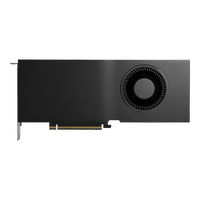
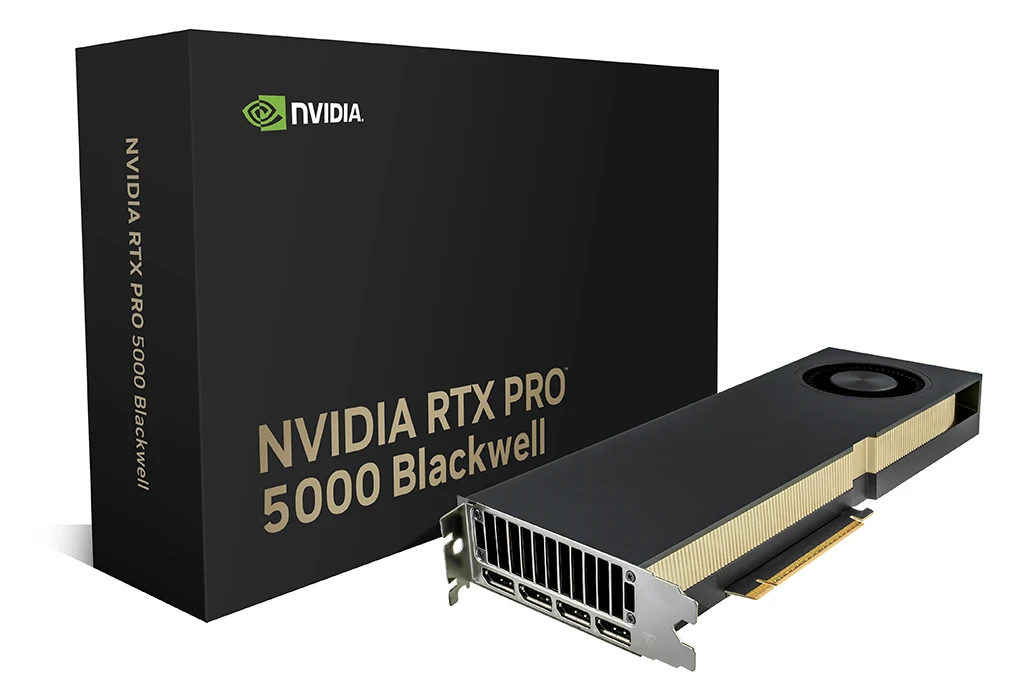
NVIDIA RTX PRO 5000 Blackwell for AI, rendering and professional workstations
The NVIDIA RTX PRO 5000 Blackwell is a professional workstation graphics card designed for demanding AI workflows, local LLMs, GPU rendering, CAD, simulations, video editing and content creation. Featuring the NVIDIA Blackwell architecture, 48 or 72 GB of GDDR7 graphics memory with ECC and powerful CUDA, Tensor and ray tracing processing units, this professional GPU can handle large models, complex datasets and extensive 3D projects directly on the workstation.
This makes the RTX PRO 5000 Blackwell suitable for AI developers, data scientists, engineers, architects, 3D artists and professional creators. Its large graphics memory provides plenty of capacity for local AI applications, high-resolution rendering and demanding multi-application workflows.
NVIDIA RTX PRO 5000 Blackwell specifications
The RTX PRO 5000 Blackwell combines professional processing performance with large amounts of ECC graphics memory and modern interfaces for demanding AI, graphics and compute workloads.
- GPU architecture: NVIDIA Blackwell
- CUDA cores: 14,080
- Tensor cores: 5th generation
- RT cores: 4th generation
- Graphics memory: 48 or 72 GB GDDR7 with ECC
- Memory bandwidth: 1,344 GB/s
- Interface: PCIe 5.0 x16
- Video engines: 3x NVENC and 3x NVDEC
- Display connectors: 4x DisplayPort 2.1b
- Maximum power consumption: 300 watts
- Form factor: Full height, dual-slot design with active cooling
RTX PRO 5000 Blackwell GPU applications
The combination of large amounts of ECC graphics memory, professional drivers and broad support for GPU-accelerated software makes the NVIDIA RTX PRO 5000 Blackwell suitable for a wide range of AI, engineering and creator workflows.
| Application | Typical workloads |
|---|---|
| Local AI and LLMs | LLM inference, local AI assistants, RAG systems and agentic AI |
| AI development | Prototyping, fine-tuning, machine learning and generative AI |
| Data science | Data analysis, model evaluation, visualisation and GPU-accelerated data pipelines |
| CAD and product development | Design, large assemblies, digital twins and engineering simulations |
| 3D rendering | Ray tracing, animation, architectural visualisation and virtual production |
| Content creation | Video editing, colour grading, motion graphics and high-resolution media projects |
| Scientific computing | Simulations, research, data processing and high-performance computing |
RTX PRO 5000 Blackwell with 48 or 72 GB of GDDR7 ECC?
Both variants use the same NVIDIA Blackwell GPU and offer the same memory bandwidth and professional features. The difference lies in the available memory capacity and the resulting project sizes each model can support.
RTX PRO 5000 with 48 GB
The model with 48 GB of GDDR7 ECC memory is suitable for local LLM inference, generative AI, CAD, BIM, GPU rendering, 3D visualisation, data science and professional video editing. It provides plenty of graphics memory for demanding workstation projects with predictable memory requirements.
RTX PRO 5000 with 72 GB
The model with 72 GB of GDDR7 ECC memory provides additional capacity for larger local LLMs, extensive context windows, fine-tuning, complex simulations, high-resolution 3D scenes and parallel AI or rendering workflows.
The most suitable model depends on factors including model size, quantisation, context length, batch size and the software being used. More graphics memory does not automatically increase processing performance, but it allows larger models and projects to run without being offloaded to slower system RAM.
RTX PRO 5000 Blackwell or GeForce RTX 5090?
The NVIDIA RTX PRO 5000 Blackwell and the GeForce RTX 5090 are both based on the Blackwell architecture, but they target different users. The GeForce RTX 5090 is a high-end graphics card for gaming, streaming and content creation and features 32 GB of GDDR7 graphics memory. It is particularly suitable for users who want to combine maximum gaming performance with powerful creator and AI features.
The RTX PRO 5000 Blackwell, on the other hand, is designed for professional workstations. Its main advantages include 48 or 72 GB of GDDR7 ECC memory, NVIDIA Enterprise drivers, ISV certifications, Multi-Instance GPU support and a design engineered for sustained professional workloads. For local AI, large CAD datasets, simulation-heavy projects and business-critical rendering workflows, the professional GPU therefore provides greater memory capacity and additional enterprise features.
Local LLMs and generative AI with the RTX PRO 5000
With up to 72 GB of local GPU memory, the NVIDIA RTX PRO 5000 Blackwell is suitable as an AI graphics card for local large language models, AI assistants, retrieval-augmented generation and agentic applications. Models and sensitive project data can be processed directly on an in-house AI workstation without every operation being transferred to an external cloud platform.
The fifth-generation Tensor cores support current AI data formats such as FP4. This can reduce the memory requirements and computational workload of compatible AI models. Depending on the framework being used, CUDA-accelerated applications for machine learning, deep learning, image generation and natural language processing can benefit from the Blackwell GPU.
Generative image and video workflows using applications such as Stable Diffusion, FLUX or ComfyUI also benefit from the large amount of VRAM. The additional memory capacity can reduce waiting times and support more extensive projects, particularly when working with high-resolution images, large batch sizes, complex workflows and several models loaded simultaneously.
GPU rendering, CAD and 3D visualisation
The fourth-generation RT cores accelerate professional ray tracing and neural rendering. This makes the RTX PRO 5000 Blackwell suitable for photorealistic product visualisations, architectural projects, animations, virtual film sets and real-time rendering in complex 3D scenes.
In GPU-accelerated applications such as Blender, Autodesk software, Unreal Engine, OctaneRender or Redshift, the workstation graphics card can perform calculations in parallel and retain large geometry, texture and scene datasets in local VRAM. ECC support also improves graphics memory reliability during long calculations and sustained professional workloads.
For CAD, CAM, CAE and BIM applications, the RTX PRO 5000 provides sufficient performance for large assemblies, engineering models, simulation results and high-resolution visualisations. Its professional drivers are designed for stability and compatibility with certified business applications.
Video editing, streaming and virtual production
The RTX PRO 5000 Blackwell features three ninth-generation NVENC encoders and three sixth-generation NVDEC decoders. This makes it suitable for multi-stream productions, high-resolution video projects, live media, virtual studios and AI-assisted post-production.
It supports modern video formats such as AV1 and H.265 as well as professional 4:2:2 workflows using H.264 and HEVC. This benefits applications including video editing, colour grading, media conversion, livestreaming and the simultaneous processing of several video sources.
Multi-Instance GPU for parallel workloads
Multi-Instance GPU allows the RTX PRO 5000 Blackwell to be divided into as many as two isolated GPU instances. Each instance receives its own compute, cache and memory resources. This allows several applications or users to work on the same professional GPU in parallel without a single process occupying all available resources.
This feature is suitable for virtualised AI environments, parallel development projects, separate inference services and the secure isolation of multiple professional workloads.
Suitable hardware for the RTX PRO 5000 Blackwell
The NVIDIA RTX PRO 5000 Blackwell delivers its full performance in a modern AI or rendering workstation equipped with a powerful processor. Suitable options include AMD Ryzen 9, AMD Ryzen Threadripper, Intel Core Ultra, Intel Xeon W or Intel Xeon 6. Workloads involving numerous CPU-based simulations, data preparation tasks and rendering operations particularly benefit from a high core count.
System memory should provide at least as much capacity as the GPU memory. For extensive AI, CAD and rendering projects, 128 GB of RAM or more is often advisable. Larger RAM capacities can provide additional headroom, particularly when using the 72 GB model or running several applications simultaneously.
Fast PCIe NVMe SSDs reduce loading times for models, datasets, textures and video footage. A separate project or scratch SSD can be useful for temporary files, AI models and media projects.
The GPU uses a PCIe 5.0 x16 connection and requires a PCIe CEM5 16-pin power connector. Due to its maximum power consumption of 300 watts, a high-quality PC power supply with sufficient performance reserves should be used. The required total power output depends on the processor, memory, drives and any additional expansion cards.
With a length of approximately 267 mm and a dual-slot design, the RTX PRO 5000 fits into many modern workstation cases. For sustained AI, rendering and simulation workloads, the case should provide well-planned airflow and sufficient access to fresh air.
FAQ – NVIDIA RTX PRO 5000 Blackwell graphics cards
Who is the NVIDIA RTX PRO 5000 Blackwell suitable for?
The GPU is designed for AI developers, data scientists, engineers, architects, 3D artists and professional creators. It is particularly suitable for local AI, LLM inference, CAD, simulations, GPU rendering and video production.
Should I choose the RTX PRO 5000 with 48 or 72 GB?
The 48 GB model already provides plenty of memory for professional AI, rendering, CAD and creator workflows. The 72 GB model is suitable for larger local LLMs, more extensive context windows, fine-tuning and particularly memory-intensive datasets or 3D scenes.
Is the RTX PRO 5000 Blackwell suitable for local LLMs?
Yes. With 48 or 72 GB of GDDR7 ECC memory, the graphics card provides a large amount of VRAM for local language models, AI assistants, RAG systems and inference workloads. The models that fit entirely into graphics memory depend on model size, quantisation and context length.
Is the RTX PRO 5000 suitable for Stable Diffusion and generative AI?
Yes. The fifth-generation Tensor cores and large graphics memory are suitable for image generation, AI upscaling, generative video workflows and applications such as Stable Diffusion, FLUX or ComfyUI.
Can I use the RTX PRO 5000 for Blender and GPU rendering?
Yes. The CUDA and RT cores accelerate compatible rendering engines and enable complex 3D scenes to be processed directly on the GPU. The large amount of VRAM is particularly useful for high-resolution textures, extensive geometry and large scenes.
Is the RTX PRO 5000 Blackwell a gaming graphics card?
The RTX PRO 5000 can run modern games and ray tracing applications, but it is primarily designed for professional workstations. A GeForce graphics card generally offers a more suitable combination of drivers, connectivity and pricing for a gaming PC.
What is the difference between the RTX PRO 5000 and the GeForce RTX 5090?
The RTX PRO 5000 provides 48 or 72 GB of ECC graphics memory, enterprise drivers, ISV certifications and Multi-Instance GPU support. The GeForce RTX 5090 features 32 GB of GDDR7 memory and is more strongly targeted at gaming, streaming and consumer creator workflows.
How much system memory does an RTX PRO 5000 workstation require?
The system RAM should provide at least as much capacity as the graphics memory. For professional AI, rendering and simulation workflows, 128 GB of RAM or more is often advisable, depending on the dataset, software and number of applications running simultaneously.
What power supply does the RTX PRO 5000 Blackwell require?
The graphics card has a maximum power consumption of 300 watts and is powered through a 16-pin connector. The required power supply capacity depends on the complete workstation configuration and should include sufficient reserves for the processor, drives and other components.