


EPYC
AMD EPYC CPUs are professional server processors for virtualisation, databases, AI applications, storage systems, and data centres. At Caseking, you will find AMD EPYC processors from various series.
AMD EPYC Processors for Servers and Data Centres
AMD EPYC processors are powerful server CPUs developed specifically for professional applications, data centres, and modern cloud infrastructures. Thanks to a high number of CPU cores and threads as well as current Zen architectures, they offer enormous compute performance for highly parallelised workloads.
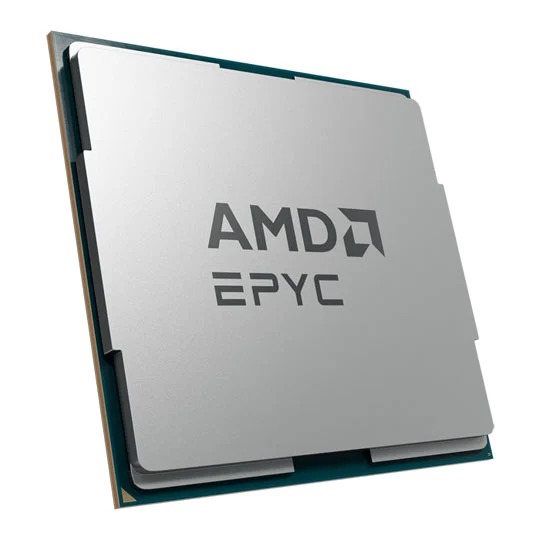
Depending on the generation, they support current technologies such as DDR5 memory, ECC RAM, and PCIe 5.0, making them ideal for virtualisation, databases, AI applications, high-performance computing, and other demanding enterprise workloads. At the same time, AMD EPYC CPUs impress with their high energy efficiency and excellent scalability.
Which AMD EPYC Generation Suits You and Your Intended Use?
Depending on the generation, EPYC CPUs have different specifications, which means that not every CPU generation is suitable for every application.
| Application | Recommended EPYC Series | Why? |
|---|---|---|
| Small Businesses & Entry-Level Servers | EPYC 4004 / 4005 | Cost-effective platform with up to 16 cores for file, web, and office servers. |
| NAS & Storage Servers | EPYC 4005 | High efficiency, ECC support, and sufficient PCIe lanes for storage solutions. |
| Edge Computing | EPYC 8004 | Optimised for high energy efficiency and compact servers. |
| Virtualisation | EPYC 9004 / 9005 | Many cores, high memory bandwidth, and numerous PCIe lanes for virtual machines. |
| Databases | EPYC 9004 / 9005 | High multi-core performance and large memory capacities for data-intensive applications. |
| AI & High-Performance Computing | EPYC 9005 | Maximum core count and high I/O bandwidth for demanding computing loads. |
| Professional Workstations | EPYC 4005 / 9004 | Depending on requirements, from compact workstations to high-end systems. |
AMD EPYC CPUs for Different Applications
AMD EPYC processors are suitable for numerous professional applications – from small business servers to large data centres. Depending on the workload, businesses benefit from a high number of CPU cores, large memory capacities, and numerous PCIe 5.0 lanes.
Virtualisation
Many CPU cores and high memory bandwidth enable the parallel operation of numerous virtual machines on a single server.
AI & Machine Learning
High compute performance and numerous PCIe 5.0 lanes create optimal conditions for multiple GPUs and demanding AI workloads.
Cloud Computing
Scalable performance and high energy efficiency make AMD EPYC processors the ideal foundation for modern cloud infrastructures.
Databases
Large memory capacities and high memory bandwidth ensure reliable performance for data-intensive applications.
Storage Servers
Numerous PCIe lanes and ECC memory enable powerful storage solutions with high reliability during continuous operation.
High-Performance Computing
Ideal for scientific calculations, simulations, rendering, and other compute-intensive applications with a high degree of parallelisation.
Overview of the Different AMD EPYC CPU Generations
EPYC CPUs currently comprise five generations,
| Feature | EPYC 4004 | EPYC 4005 | EPYC 8004 | EPYC 9004 | EPYC 9005 |
|---|---|---|---|---|---|
| Architecture | Zen 4 | Zen 5 | Zen 4c | Zen 4 / Zen 4c | Zen 5 / Zen 5c |
| Max. Cores / Threads | Up to 16 / 32 | Up to 16 / 32 | Up to 64 / 128 | Up to 128 / 256 | Up to 192 / 384 |
| Socket | AM5 | SP6 | SP5 | ||
| Memory Support | DDR5 ECC UDIMM | DDR5 ECC Registered (RDIMM) | |||
| Memory Channels | 2 | 6 | 12 | ||
| PCIe Version | PCIe 5.0 | ||||
| Max. PCIe Lanes | 28 | 96 | 128 | ||
DDR5 and ECC Memory
Depending on the series, AMD EPYC processors support different DDR5 memory types. The EPYC 4004 and EPYC 4005 models use DDR5 ECC UDIMM. The more powerful EPYC 8004, EPYC 9004, and EPYC 9005 series, by contrast, support DDR5 ECC Registered DIMM (RDIMM). This memory, which was developed specifically for servers, enables significantly higher memory capacities and high reliability during continuous operation. Regardless of the series, the ECC function (Error Correcting Code) ensures that memory errors are automatically detected and corrected – an important advantage for virtualisation, databases, and other business-critical applications.
Suitable Motherboards for EPYC CPUs
For AMD EPYC processors, you need a motherboard with the appropriate socket and server chipset. The EPYC 4004 and EPYC 4005 series use the AM5 socket, while EPYC 8004 uses the SP6 socket. For EPYC 9004 and EPYC 9005, an SP5 motherboard is required. Also make sure that the motherboard supports the respective processor via BIOS and is compatible with the intended memory.
- EPYC 4004 / 4005: AM5 motherboards with suitable server support
- EPYC 8004: SP6 server motherboards
- EPYC 9004 / 9005: SP5 server motherboards
Why Are Numerous PCIe Lanes Important for Servers?
The number of PCIe lanes determines how many expansion cards and high-speed storage devices can be operated simultaneously at full performance. This is particularly important in servers, where several NVMe SSDs, powerful network cards, or GPUs are often used in parallel. While the EPYC 4004 and EPYC 4005 series are sufficiently equipped for smaller servers with 28 PCIe 5.0 lanes, EPYC 8004 offers up to 96, and EPYC 9004 and EPYC 9005 even offer up to 128 PCIe 5.0 lanes. This makes these processors particularly suitable for virtualisation, AI applications, storage servers, and other compute-intensive enterprise workloads that require high expandability.
FAQ – AMD EPYC CPUs
What Is the Difference Between AMD EPYC and AMD Ryzen?
AMD EPYC processors were developed specifically for servers and data centres. Compared with Ryzen CPUs, they offer significantly more CPU cores, higher memory capacities, ECC support, more PCIe lanes, and features for professional continuous operation.
What Advantages Do Numerous PCIe 5.0 Lanes Offer?
Numerous PCIe lanes enable the simultaneous operation of multiple GPUs, NVMe SSDs, RAID controllers, and network cards with high bandwidth. This is particularly beneficial for virtualisation, AI applications, databases, and storage servers.
What Is the Difference Between ECC UDIMM and ECC RDIMM?
ECC UDIMM is used primarily in entry-level servers and workstations. ECC RDIMM additionally features a register component, enabling larger memory capacities and greater stability on professional server platforms.
What Advantages Do 12 Memory Channels Offer?
More memory channels significantly increase memory bandwidth. Applications such as virtualisation, high-performance computing, databases, or AI benefit because large amounts of data can be transferred more quickly between the memory and processor.
Do AMD EPYC Processors Support Dual-Socket Systems?
Not all EPYC series support operation with two processors. While EPYC 4004, EPYC 4005, and EPYC 8004 are designed for single-socket servers, many models in the EPYC 9004 and EPYC 9005 series also support dual-socket configurations for maximum compute performance.
Are AMD EPYC Processors Suitable for AI Applications?
Yes. Thanks to their high core count, large memory capacities, and numerous PCIe 5.0 lanes, AMD EPYC CPUs are highly suitable as a platform for AI servers with multiple GPUs and fast NVMe SSDs.
Which Motherboards Do I Need for AMD EPYC Processors?
Depending on the processor series, a motherboard with an AM5, SP6, or SP5 socket is required. In addition, the motherboard should support the respective processor via BIOS and be compatible with the intended ECC memory.
Why Is ECC Memory Used Almost Exclusively in Servers?
ECC memory automatically detects and corrects memory errors. This reduces crashes, data errors, and failures – a decisive advantage for servers that need to operate reliably around the clock.
Nothing found...
Unfortunately, we have not found anything.
Try a different search term or category: RTX 5090 , RX 9070 , Gaming PC , Ryzen 9 , Moza
Your Caseking team
Learn some of our tips for a perfect search:
- Check the text you entered for errors
- Try to use related words for your search term
- Refine your search by selecting a few categories as a filter to get to the result you want